Guide
The Ultimate Guide to Buying Commercial Cleaning Supplies in Bulk
Sep
TL;DR
This guide is for procurement specialists tightening up an existing ordering process and small business owners working out bulk buying for the first time. Either way, you’ll learn how to:
- Calculate exactly how much stock to order (par levels)
- Store bulk chemicals and paper safely without losing product to shelf life or damp
- Know which categories (paper, chemicals, PPE) actually save the most money in bulk
- Decide when a one-off pallet order is enough and when a trade account pays for itself
How much money is your business losing on emergency, last-minute cleaning supply orders?
For many facilities, cleaning supplies are forgotten until the paper towels run out mid-shift or a disinfectant reorder gets missed for the third month in a row.
Moving to a structured bulk procurement strategy changes that. Whether you manage a single site or multiple facilities, the core objective is simple: know what you use, secure trade pricing, and optimise your store room space.
This guide focuses specifically on bulk buying. For broader cost-saving tactics like comparing suppliers, loyalty discounts, and hunting for deals, see our guide on how to save money when buying cleaning products for your business.
The biggest savings come from two key moves: buying your highest-volume items by the pallet and upgrading to a trade account once your spend justifies it. This guide covers everything you need to execute both.
Advantages of Buying Cleaning Supplies in Bulk
Buying cleaning supplies in bulk is a cost-efficient way to ensure you constantly have the stock you need to keep your facility running without unexpected shortages.
- Save Money & Delivery Fees: Purchasing larger trade sizes or buying by the case drops your unit cost significantly. Moving from small retail bottles to 5L concentrates or buying paper products by the pallet yields immediate cost savings while easily clearing minimum spend thresholds for free direct delivery.
- Safeguard Against Supply Shortages: Unpredictable supply chain delays or sudden seasonal demand surges can leave facilities short on critical items. Keeping a healthy safety stock buffer ensures your site stays operational and fully stocked with essential products.
- Save Administrative Time: Managing individual orders for paper, soaps, PPE, and specialised chemicals creates constant admin hassle. Switching to a monthly or termly bulk order reduces procurement tasks, invoice processing, and stocktaking headaches.
- Simplify COSHH & Safety Compliance: Bulk-buying concentrated chemicals for use with controlled dosing systems keeps staff safe, reduces over-mixing, and ensures your site uses standardised COSHH-compliant products with matching Safety Data Sheets (SDS).
- Reduce Environmental Impact: Ordering bulk concentrates and larger cases drastically reduces single-use plastic waste and packaging materials. Consolidating your orders into fewer delivery drops also cuts carbon emissions across your supply chain.
Calculating Your Par Levels: How Much Stock Do You Need?
Before placing a bulk order, work out your par level (the minimum stock you need on hand before it’s time to reorder).
The Basic Formula:
Par Level = (Average Daily Usage × Lead Time in Days) + Safety Buffer
Example:
- An office of 50 staff typically uses around 2–3 hand towels per person per day, call it 125 towels daily.
- Your supplier’s lead time is 5 working days.
- Baseline stock needed to cover that lead time: 125 × 5 = 625 towels.
- Add a safety buffer of 20% for unexpected busy periods or delivery delays: 750 towels as your par level
For paper specifically, our Bulk Toilet Paper Buying Guide breaks par levels down by roll system and footfall.
Warehouse & Store Room Management: Storage, Shelf Life & Safety
Bulk buying only saves money if the stock survives long enough to be used.
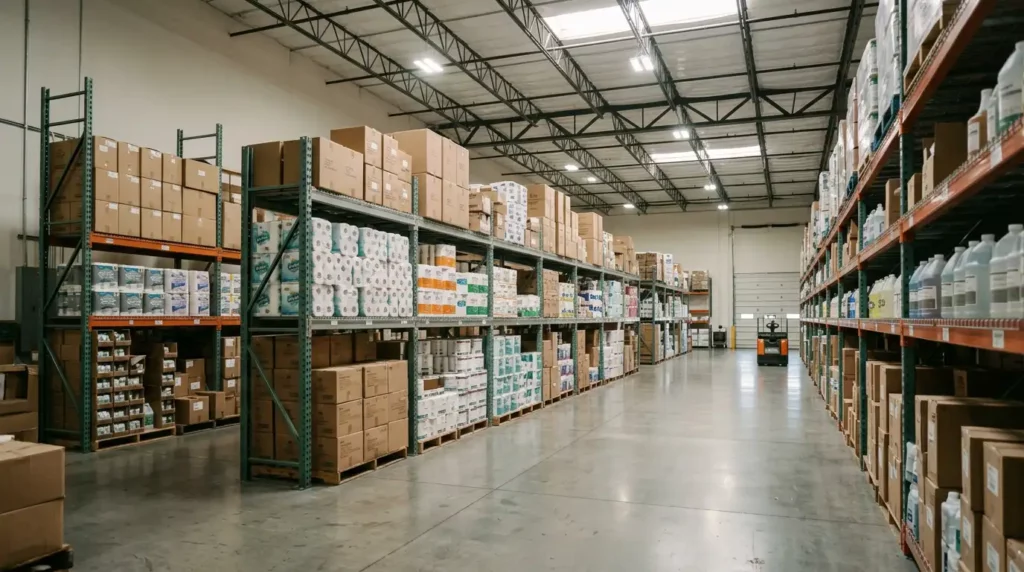
- Check your space. A standard UK pallet needs a footprint of roughly 1.2m x 1.0m and can stand up to 2m tall. Tight on room? Start with a half-pallet or individual cases instead.
- Keep it cool and dry. Heat and damp degrade chemicals faster and can cause paper products to swell or spoil.
- Rotate your stock. Use FIFO (first in, first out) so nothing sits unused past its shelf life.
Not every product behaves the same way in storage. Paper and PPE generally store well for extended periods, while some chemicals (bleach in particular) lose potency within months of opening. Our guide, Do Cleaning Products Expire?, covers what to watch for by product type.
High-Margin Categories: Which Supplies Yield the Biggest Savings?
Not every product category delivers the same return on investment when bought in bulk. To maximise your budget, prioritise items with high turnover rates and minimal storage risks:
- Paper Consumables (The Safest Bet): Predictable usage rates, long shelf lives (typically years, not months), and zero dilution risks make paper products the easiest starting point. If you only bulk buy one category, start here. Explore our pallet deals on bulk toilet rolls, paper hand towels, and centrefeed rolls.
- Concentrated Chemicals (The Biggest Savings): Switching to concentrated formulas cuts cost per dose dramatically but requires active shelf-life management. Only bulk order volumes your site will use within the active product window. Browse trade-grade options in our Industrial Cleaning Supplies range.
- Disposable PPE (The Low-Risk Essential): With steady daily usage and no expiration dates to manage, bulk PPE purchasing is ideal for healthcare settings, commercial kitchens, and cleaning contractors. Shop bulk options in our PPE, Safety & Workwear category.
Pallet Deals vs Trade Accounts: Securing Long-Term Value
A single pallet order is an effective way to test bulk buying for your facility. However, once bulk procurement becomes central to your site operations, upgrading to a trade account unlocks better long-term value.
- Schools & Nurseries: Lock in fixed, predictable pricing that aligns directly with termly operating budgets.
- Commercial Cleaning Contractors:
- Manage multi-site supply needs with consistent stock availability and centralised billing.
- Offices & Healthcare Facilities: Ensure uninterrupted stock delivery without tying up capital through rigid one-off purchases.
Don’t Forget: Spending over £100 per month on janitorial and washroom consumables? Skip one-off orders and open a trade account to secure trade credit terms, dedicated support, and exclusive volume pricing
Common Bulk-Buying Mistakes to Avoid
Watch out for these four:
- Buying on price alone. Cheaper chemicals often have lower concentrations, so you use more per task. Check cost-per-use, not just cost-per-bottle.
- Skipping the par level calculation. Guessing “a bit more than usual” leads to running out of stock, or tying up cash you don’t need to spend.
- Underestimating storage space. A pallet looks fine on an order form. Measure your storeroom first.
- Ignoring shelf life on chemicals. Bleach loses potency within six months of opening. Buying a year’s supply to save 10% isn’t a saving if half of it doesn’t work.
Quick Bulk-Buying Checklist
Before placing your next wholesale order, run through this quick checklist to ensure your site is prepared to maximise savings and handle bulk deliveries:
- Calculate Site Par Levels: Have you calculated your minimum stock baseline (daily usage × lead time + safety buffer) for your highest-turnover paper and chemical consumables?
- Audit Storage Space: Do you have a clean, dry, climate-controlled space ready to receive pallet dimensions (1.2m x 1.0m, up to 2m high)?
- Check Chemical Shelf-Life Limits: Have you verified usage rates against active chemical shelf lives so products won’t degrade before being fully used?
- Review Monthly Spend: Does your facility spend over £100 per month on cleaning and washroom supplies? If so, have you applied for a trade account to unlock trade credit terms and dedicated account pricing?
Frequently Asked Questions
Yes. Buying by the case or pallet significantly reduces cost-per-unit compared to retail packs, especially on paper and PPE, where there’s no shelf-life risk to offset the saving.
A pallet deal is a one-off bulk purchase at a discounted rate. A trade account is an ongoing arrangement with ongoing discounted pricing and credit terms, best for businesses reordering regularly.
Some do. Paper and PPE store well long-term; chemicals like bleach degrade faster. Our Do Cleaning Products Expire? guide breaks it down by product type.
Yes. If your facility spends over £100 a month on washroom and janitorial supplies, you can sign up for a trade account for credit terms, dedicated support, and exclusive volume discounts.

UK Cleaning Supplies Expert Insights Team
Trusted Commercial Cleaning & Hygiene Solutions
UK Cleaning Supplies supports businesses, schools, and facilities nationwide with trade-grade products, wholesale cost savings, and professional advice.
Our Expert Insights Team brings together industry knowledge across commercial cleaning, chemical procurement, and facilities management to share practical guidance that helps you maintain a safer, cleaner, and more cost-effective working environment.