
Guide
Preventing Slips and Trips This Winter: A Floor Cleaning and Safety Checklist for UK Workplaces
Sep
Why slips rise in autumn and winter
Slips and trips are the single most common cause of major injury in UK workplaces, according to the Health and Safety Executive. From late October, the clocks go back, evenings get darker and rain, wet leaves and grit get walked straight through your front door.
The good news is that most slips are preventable. HSE notes that people rarely slip on clean, dry floors, and that almost every slip involves some kind of contamination, such as water, grease or dust. How and when you clean decides whether your floors stay safe or become a hazard.
This guide covers what HSE expects from your cleaning regime, how to clean without creating new slip risks, how to use wet floor signs properly, and a daily winter checklist you can print for your team.
What HSE expects from your cleaning regime
The law puts the responsibility on employers and anyone managing premises. HSE’s information sheet Slips and trips: The importance of floor cleaning summarises the main duties:
- Management of Health and Safety at Work Regulations 1999: you must assess slip and trip risks to employees and others, and act to control them. If you bring in cleaning contractors, you must give them health and safety information about your premises.
- Workplace (Health, Safety and Welfare) Regulations 1992: floors must be suitable for their use and free from obstructions and slip hazards.
- Provision and Use of Work Equipment Regulations 1998: cleaning equipment such as mops and scrubber-driers must be suitable, well maintained, and staff must be trained to use it.
In practice, HSE says a good cleaning system needs three things working together:
- A management system: plan the right regime for each floor type, check it is being followed, and review it when things change.
- Contamination control: stop contamination reaching the floor, choose the right cleaning method, and make sure cleaning itself does not leave the floor slippery.
- Obstacle removal: keep walkways clear of trailing cables, bin bags and equipment.
Training matters too. HSE’s case studies show that the wrong technique, or the wrong detergent strength, can make a floor more slippery than before it was cleaned. Your cleaning risk assessment is the right place to record how you manage slips through winter.
Timing wet cleaning: keep people off drying floors
Mopping is one of the main reasons floors are left wet after cleaning. HSE points out that even a well-wrung mop leaves a thin film of water, and on a smooth floor such as vinyl or glazed tile that film is enough to cause a slip.
If you cannot switch to a method that leaves the floor dry, the floor must be left to dry completely before people walk on it. HSE ranks the ways of keeping people off a drying floor, from most to least effective:
- Clean during quiet hours. Early mornings, evenings or before opening mean fewer people cross wet floors. This matters more in winter, when dark evenings and wet weather slow drying.
- Physically exclude people. Use barriers or lock off the area until it is dry, and signpost an alternative route. Remove the barrier as soon as the floor is dry.
- Clean in sections. Mop one half of a corridor or room, let it dry, then do the other half, so there is always a dry path through.
- Use warning signs. Signs are the least effective option on their own, because they warn of a hazard rather than keeping people away from it. More on this below.
Other HSE tips that help through winter:
- Spot clean small spills with a paper towel or cloth instead of mopping a large area. It stops a small, visible spill becoming a large, invisible wet patch. Paper hand towels or centrefeed rolls kept near entrances make this quick.
- Park your trolley next to the spill, not across the room, so the mop does not drip a trail on the way.
- Use a wet vacuum or scrubber-drier on larger smooth floors where possible, as these can leave the floor far drier than a mop. Our guide to floor cleaning machines explains the options.
- Keep cables short and visible. Plug vacuums into the nearest socket, or use battery equipment, so cables do not cross walkways.
Wet floor signs: when to use them and when to remove them
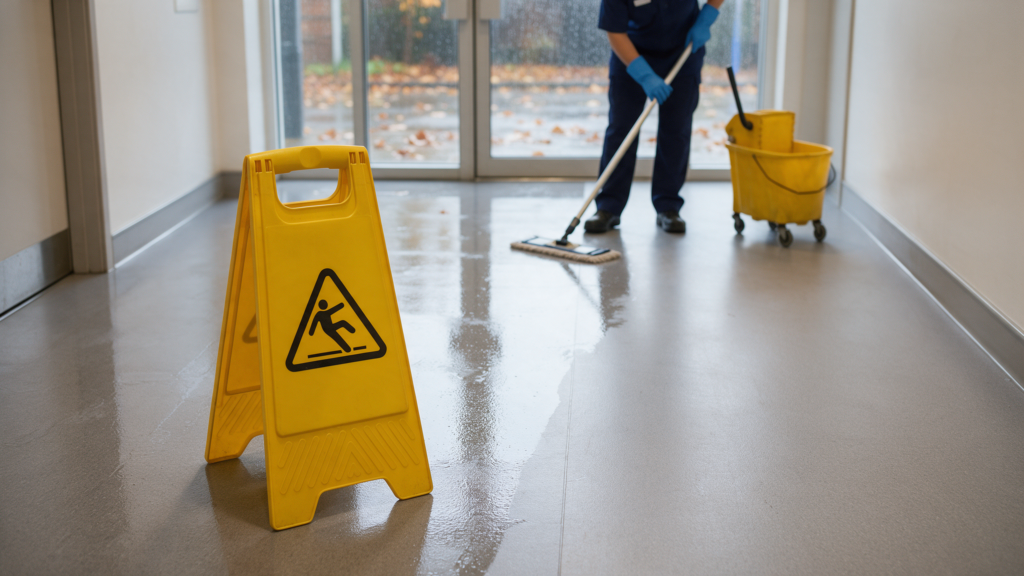
Wet floor signs are useful, but only when they are used properly. HSE is clear that signs and cones warn of a hazard but do not stop people walking into it. They should be used alongside the steps above, not instead of them.
HSE highlights three common problems with cones and signs:
- They do not physically prevent people from entering the wet area.
- They often do not show clearly how far the wet area extends.
- They are frequently left out after the floor is dry, so people learn to ignore them.
To get the most from your signs:
- Put them out before you start wet cleaning or as soon as a spill is spotted, not halfway through.
- Place them at every approach to the wet area, so people see them whichever way they come in. On a long corridor, that means both ends.
- Make them visible. In darker winter conditions, taller signs are easier to spot. Our Banana Wet Floor Safety Cones come in 60cm and 90cm heights with the warning printed on all four sides.
- Remove them as soon as the floor is dry. This is the step most often missed, and it is what keeps signs effective. HSE notes that a sign is most effective when it is clearly linked to a visible hazard and taken away once the area is safe.
- Store them where they are needed. Keep signs on the cleaning trolley or by the entrance so there is no excuse not to use them.
For everyday use, a folding Caution Wet Floor A-Frame Sign is lightweight, printed on both sides and folds flat for storage. See the full range of cleaning safety signs.
Mops and floor cleaners that do not leave floors slippery
The right equipment and chemicals make as much difference as the right routine. A floor left with greasy residue or a film of dirty water is a slip risk, however carefully it was mopped.
Get the detergent strength right. HSE warns that water alone does not remove greasy or oily contamination, and that detergent that is too strong can be as ineffective as too weak. Always follow the manufacturer’s dilution rate. In one HSE case study, a food factory floor stayed slippery because staff had drifted into using one capful of detergent, well below the recommended amount. Dosing and dilution systems take the guesswork out.
Give detergent time to work on greasy floors. HSE recommends a two-stage method for kitchens and similar areas: put the solution down, leave it to soak, then mop it up.
Keep dirty water out of the clean. Wringing into a separate dirty water bucket means you are not spreading grime back across the floor. A two-bucket or divided mop system does this well, and our mops and buckets buying guide explains which suits each floor type.
Use colour coding. Separate mops for washrooms, kitchens and general areas stop contamination moving between zones. See the art of colour-coded cleaning.
Change mop heads and water often. Winter floors pick up far more grit and mud. Dirty water and worn mop heads leave residue behind, so refresh them more frequently in wet weather.
Choose the right chemical for the floor. Check that your floor cleaner is suitable for the surface, whether that is vinyl, sealed wood, stone or tile. The wrong product can dull a finish or leave a slippery film. If you are unsure, our team can advise.
Consider slip-resistant footwear for cleaners. HSE notes that cleaners face slip risks from their own work, and that footwear provided as personal protective equipment must be free to employees. Browse our workwear and safety range.
Entrances: managing rain, leaves and grit
Entrances are where most winter contamination gets in, so they need the most attention. HSE’s advice is to stop contamination reaching the floor in the first place, and to check whether it is being walked further in than it should be.
- Clear outside approaches daily. Wet, rotting leaves on steps and paths are a serious slip hazard. One HSE case study describes a hospital worker who slipped on leaves that should have been cleared daily but were missed due to staff shortages. A stiff broom and litter picker make quick work of it.
- Use effective, well-maintained matting. HSE recommends entrance matting to stop floors getting wet. Check that mats lie flat, as curling edges are a trip hazard, and clean or replace them when they become saturated.
- Provide somewhere for wet umbrellas. HSE suggests enclosed umbrella holders at entrances so drips stay off the floor.
- Increase spot checks in wet weather. On rainy days, check entrance floors every hour or so, and keep paper towels, a mop and a wet floor sign close to the door.
- Look for design fixes. HSE points to simple changes such as canopies over entrances and fixing leaking roof lights or gutters that drip onto walkways.
- Report lighting problems. With darker evenings, blown bulbs in corridors, stairwells and car park routes make trip hazards harder to see.
Once gritting starts, salt and grit will be walked indoors too. We will cover how to remove winter salt residue from floors and carpets in a dedicated guide in January.
Daily winter floor safety checklist
Print this out and keep it on the cleaning trolley or by the entrance.
Before opening
- Clear leaves, litter and debris from outside steps and paths
- Check entrance mats are flat, dry enough to work, and not curling
- Complete wet cleaning of main walkways, leaving time to dry
- Remove all wet floor signs from areas that are now dry
- Check lighting on corridors, stairs and entrances
During the day
- Spot check entrance floors regularly, more often in rain
- Spot clean spills straight away with paper towels or a cloth
- Put out a wet floor sign as soon as a spill is found, and remove it once dry
- Keep walkways clear of boxes, bin bags and trailing cables
- Report floor damage, leaks or blown bulbs
After closing
- Clean floors in sections, or behind barriers, so there is always a dry route
- Check detergent is diluted to the manufacturer’s rate
- Rinse and change mop heads and water
- Store signs, cables and equipment out of walkways
- Note any problem areas for the next shift
Frequently asked questions
Is a wet floor sign a legal requirement in the UK?
The law requires employers to assess slip risks and keep floors free from slip hazards, but HSE treats warning signs as the least effective control. Signs help, but on their own they are unlikely to be enough. Cleaning during quiet times, barriers and cleaning in sections should come first.
How long should a wet floor sign stay out?
Until the floor is completely dry, and no longer. Signs left out on dry floors teach people to ignore them, which HSE identifies as one of the main reasons signs fail.
Why is my floor still slippery after mopping?
Common causes include a thin film of water left by the mop, detergent at the wrong strength, or greasy residue that was spread rather than removed. HSE recommends checking dilution rates, using a separate dirty water bucket and giving detergent time to work on greasy floors.
What is the best way to clean up a small spill?
Spot clean it with a paper towel or cloth rather than mopping a wide area. HSE describes this as a cheap and effective method that stops a small spill turning into a larger wet patch. For greasy spills, you will need detergent.
Who is responsible if a visitor slips?
Employers and those in control of premises have duties towards visitors and members of the public, as well as staff. If you use cleaning contractors, you must share health and safety information about your premises with them. For advice on your specific situation, refer to HSE’s slips and trips guidance.
Get your site winter-ready
Most winter slips come down to a wet or dirty floor and a cleaning routine that has not adapted to the season. Clean at quiet times, keep people off drying floors, dilute chemicals correctly, and use wet floor signs properly, putting them out promptly and taking them away once the floor is dry.
UK Cleaning Supplies has supplied commercial cleaning products since 1979. Stock up now on wet floor signs, mops and buckets and floor cleaners before the wet weather sets in, with free UK delivery on orders over £185. Need advice on the right products for your floors? Call us on 0800 3898 690 or email info@ukcleaningsupplies.co.uk.
Related reading:
- Commercial Mops and Buckets Buying Guide: Which Type for Which Floor?
- The Professional Guide to Floor Care
- A Guide on Cleaning Risk Assessments
- Top 10 Essential Tools for Every Janitor’s Cleaning Trolley

UK Cleaning Supplies Expert Insights Team
Trusted Commercial Cleaning & Hygiene Solutions
UK Cleaning Supplies supports businesses, schools, and facilities nationwide with trade-grade products, wholesale cost savings, and professional advice.
Our Expert Insights Team brings together industry knowledge across commercial cleaning, chemical procurement, and facilities management to share practical guidance that helps you maintain a safer, cleaner, and more cost-effective working environment.