
Guide
Laundry Sanitiser: What It Is, When to Use It & Is It Worth It?
Oct
Introduction
Detergent gets laundry clean. It does not always get it hygienically clean, especially on the low-temperature washes most of us now use to save energy. That gap is what laundry sanitiser is for.
In this guide, we cover what laundry sanitiser is, how it works, when it is worth using (and when it is not), and how to use it safely. Whether you are washing gym kit at home or running the laundry for a care home, salon, or nursery, you will know by the end whether you need a laundry disinfectant and which type.
Quick note on spelling: you will see it written as laundry sanitizer on US sites and many UK supermarket listings. It is the same product.
What is laundry sanitiser?
Laundry sanitiser is an antibacterial additive that you use alongside your normal detergent. Detergent lifts dirt and stains; the sanitiser kills bacteria that survive the wash. It does not replace detergent.
There are two main types, and they work very differently:
- Quaternary ammonium (“quat”) sanitisers. Most household products, such as Dettol Laundry Sanitiser, use these. Dettol’s version contains didecyldimethylammonium chloride and benzalkonium chloride as its antibacterial agents and is listed as free from bleach. It claims to kill 99.9% of bacteria and is dosed through the fabric conditioner drawer.
- Chlorine-based (hypochlorite) sanitisers. Commercial laundries often use these. Our Clover Laundry Sanitiser 5L is based on a stabilised hypochlorite and is dosed into the final rinse by an automatic dosing system. It is designed for premises that launder infected fabrics, such as care homes and hospitals.
Knowing which type you have matters. It changes which fabrics you can use it on and which products you must never combine it with (more on both below).
Does laundry sanitiser actually work? Is it worth it?
Yes, it works, but whether it is worth paying for depends on what you wash and how hot you wash it.
NHS uniform guidance gives a useful baseline. It states that washing with detergent at 30°C removes most micro-organisms, including MRSA, and that a ten-minute wash at 60°C removes almost all of them. So, for everyday household laundry with no one unwell, detergent alone usually does the job.
The catch is that a 60°C setting does not always mean 60°C. Research from De Montfort University found that only three of six domestic washing machines tested met the NHS disinfection standard, and some never reached 60°C or did not hold it long enough.
Laundry sanitiser is worth it when:
- You wash at 30°C or 40°C and want an extra hygiene step
- The fabric cannot go above 40°C but needs to be hygienically clean
- Someone in the household or setting is unwell
- You are laundering items for vulnerable people (care homes, nurseries)
- Items carry persistent odour from bacteria, such as gym kit or damp towels
It is probably not worth it when you are washing lightly worn everyday clothes, at the right temperature, in a household where no one is ill.
When to use laundry sanitiser
Use it for loads where bacteria and odour are a real concern, rather than on every wash.
Low-temperature washes. Dettol states its sanitiser is proven to work in rinse temperatures as low as 15°C, which makes antibacterial laundry possible on a cold or 30°C cycle.
Odour removal: gym clothes, sportswear and towels.
Lingering smells on synthetic sportswear and towels are usually caused by bacteria. Dettol’s household sanitiser lists gym kit, towels and bedding among its intended uses and says it targets odour-causing bacteria at source.
Workwear and uniforms.
NHS guidance recommends washing uniforms at the hottest temperature the fabric allows and separately from other clothes. A sanitiser adds a safety margin where the machine may not hit its stated temperature.
Care homes, gyms, salons, and nurseries.
Any setting that launders towels, bedding or uniforms in volume for several people benefits from a consistent hygiene step. For high-risk linen in care settings, a commercial chlorine-based sanitiser dosed automatically is the more controlled option (see below).
Bedding and towels.
These are washed less often, used close to the skin and shared in many workplaces, so they are good candidates for sanitising.
Where do you put laundry sanitiser in the washing machine?
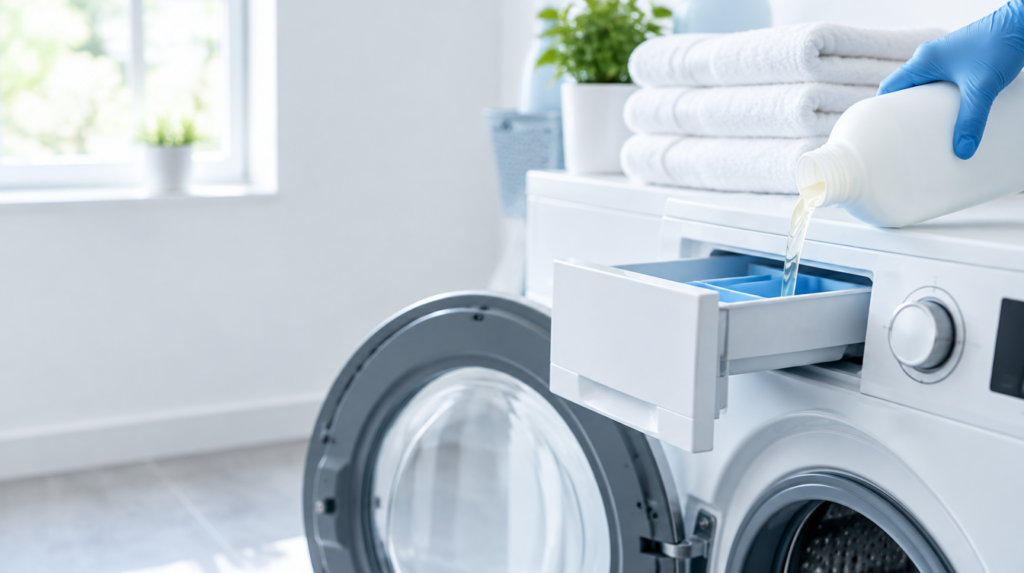
For household quat-based sanitisers, it goes in the fabric conditioner drawer, not the detergent drawer. That way it is released in the final rinse, after the detergent has done its job. Dettol’s instructions are two capfuls in the fabric softener drawer per wash.
Commercial chlorine-based sanitisers work differently. Clover Laundry Sanitiser is designed to be dosed automatically into the final rinse through a dosing system, at 150ppm available chlorine. It is not meant to be poured into a drawer by hand.
Whichever you use:
- Read the label for the exact dose; more is not better.
- Add your normal detergent to the main wash compartment as usual.
- Do not pour sanitiser directly onto dry clothes.
- Wear gloves and avoid splashes. Dettol’s laundry sanitiser label warns it can cause serious eye damage.
For general machine tips, see our guide on how to do laundry.
Is laundry sanitiser safe for colours and delicates?
It depends on the type, so always check the label before you wash anything you would not want to replace.
- Quat-based sanitisers (such as Dettol’s) are bleach-free. Dettol lists them as suitable for bedding, towels, clothes, underwear, children’s clothes (aged 2+) and gym kit.
- Chlorine-based sanitisers are a different matter. Our Clover Laundry Sanitiser product page notes that its hypochlorite base can affect some fabrics, so it suits whites and hard-wearing linen better than coloured or delicate items.
For wool, silk and other delicates, follow the garment’s care label and the sanitiser manufacturer’s guidance. If neither says it is suitable, test on a hidden area first or leave it out.
Laundry sanitiser vs fabric conditioner vs bleach
They sit in similar places in the wash but do different jobs.
| Laundry sanitiser | Fabric conditioner | Chlorine bleach | |
|---|---|---|---|
| Main job | Kills bacteria, removes odour | Softens fabric, reduces static | Disinfects and whitens |
| Kills bacteria | ✓ Yes | ✗ No | ✓ Yes |
| Where it goes | Conditioner drawer (commercial: final rinse via dosing) | Conditioner drawer | As the label directs |
| Safe on colours | Check label | ✓ Yes | ✗ No |
Laundry sanitiser vs fabric conditioner. Fabric conditioner, such as our Clover / Puriti Fabric Conditioner, makes laundry feel softer. It has no antibacterial action. Because household sanitisers go in the same drawer, check the sanitiser label before adding both to one wash.
Laundry sanitiser vs bleach: which is better? Chlorine bleach is a strong disinfectant, but it strips colour and can weaken fabric. A quat-based laundry sanitiser is the gentler choice for coloured clothes and everyday hygiene. For whites and high-risk linen in commercial settings, a controlled chlorine-based sanitiser is the standard approach. For more on the difference, read our guide to bleach vs disinfectant.
Safety: never mix laundry sanitiser with bleach
Never combine laundry sanitiser with bleach or any other cleaning product unless the manufacturer says you can. Mixing cleaning chemicals can release toxic gases. London Fire Brigade attended at least ten incidents in one year linked to mixed household cleaners, some of which put people in hospital.
This also applies to commercial chlorine-based sanitisers, which are already hypochlorite-based. Adding bleach, acids or other products to the same wash or dosing line is not safe.
- Use one sanitising product per wash
- Keep products in their original, labelled containers
- Wear gloves and eye protection when handling concentrates
- Store chemicals securely and away from children
It is also worth knowing that Dettol’s laundry sanitiser is listed as free from bleach. If you are wondering whether Dettol and bleach can be combined in the wash, the answer is no: do not mix them.
Commercial and bulk laundry sanitiser
For businesses, the question is not just whether to sanitise but how to do it consistently across every load.
In care homes, hospitals and other premises that launder infected or high-risk fabrics, a commercial laundry disinfectant dosed automatically gives you control that a capful by hand cannot. Clover Laundry Sanitiser 5L is built for exactly this. It is dosed into the final rinse at 150ppm available chlorine, which the product page notes is the Department of Health recommendation, and it is designed to reduce the risk of cross-infection from laundered fabrics.
Buying in bulk 5L containers also cuts cost per wash and the time spent reordering. Pair your sanitiser with the rest of your wash chemistry:
- Clover / Puriti Laundry Detergent for the main wash
- Clover / Puriti Laundry Chlorine Destainer for stained whites
- Soluble Strip Laundry Sacks x 200 for handling soiled linen
Browse the full range in our laundry supplies category.
Laundry sanitiser FAQs
Often not. NHS guidance says a ten-minute wash at 60°C removes almost all micro-organisms. But domestic machines do not always reach or hold that temperature, so a sanitiser is a sensible backup for high-risk items.
Yes. This is where it adds most value. Dettol states its laundry sanitiser works in rinse temperatures as low as 15°C.
Many household products claim this. Dettol’s, for example, claims to kill 99.9% of bacteria. Always check the specific product label for what it has been tested against.
No. Detergent cleans; sanitiser kills bacteria. Use both together.
Some products allow it. Dettol gives separate soaking instructions on its label, so follow those exactly rather than guessing a dilution.

UK Cleaning Supplies Expert Insights Team
Trusted Commercial Cleaning & Hygiene Solutions
UK Cleaning Supplies supports businesses, schools, and facilities nationwide with trade-grade products, wholesale cost savings, and professional advice.
Our Expert Insights Team brings together industry knowledge across commercial cleaning, chemical procurement, and facilities management to share practical guidance that helps you maintain a safer, cleaner, and more cost-effective working environment.