
Guide, Product Spotlight, Tips
Spill Kits Explained: What Every Workplace Needs and How to Choose One
Jul
A spilt drum of oil or a cracked bottle of chemical takes seconds to happen and hours to clean up properly, if you have not already got the right kit sitting nearby. Without one, staff improvise with paper towels or sawdust, the spill spreads further, and what should have been a five-minute job turns into a drain closure, a call to the Environment Agency, or a slip injury.
A spill kit solves this by putting everything you need for a safe, fast clean-up in one place: absorbents to soak up the liquid, socks or booms to stop it spreading, and the bags and gloves to dispose of it safely afterwards.
This guide explains the three main types of spill kit, what size your workplace actually needs, and how spill kits fit into your wider COSHH and risk assessment obligations.
Quick Answer
Choose a general spill kit for water-based, non-hazardous liquids. Choose a chemical spill kit for acids, solvents and other hazardous substances. Choose an oil and fuel spill kit for oils, diesel and similar hydrocarbons, since general absorbents will not contain them safely. Size your kit (20L, 40L or 120L) to the largest realistic spill in your workplace, not the smallest.
Key takeaways
- Spill kits are grouped by what they absorb: general, chemical, or oil and fuel. Using the wrong type can make a spill worse rather than better.
- Kit size should match your biggest container or drum on site, not an average spill.
- Under COSHH, having a way to contain and clean up spillages quickly is one of the control measures the Health and Safety Executive (HSE) expects employers to have in place.
- Oil and fuel spills carry extra legal weight because of their environmental impact, and used absorbents typically need to be disposed of as hazardous waste.
- A spill kit is only useful if staff know where it is and how to use it, so placement and basic training matter as much as the kit itself.
What is a spill kit?
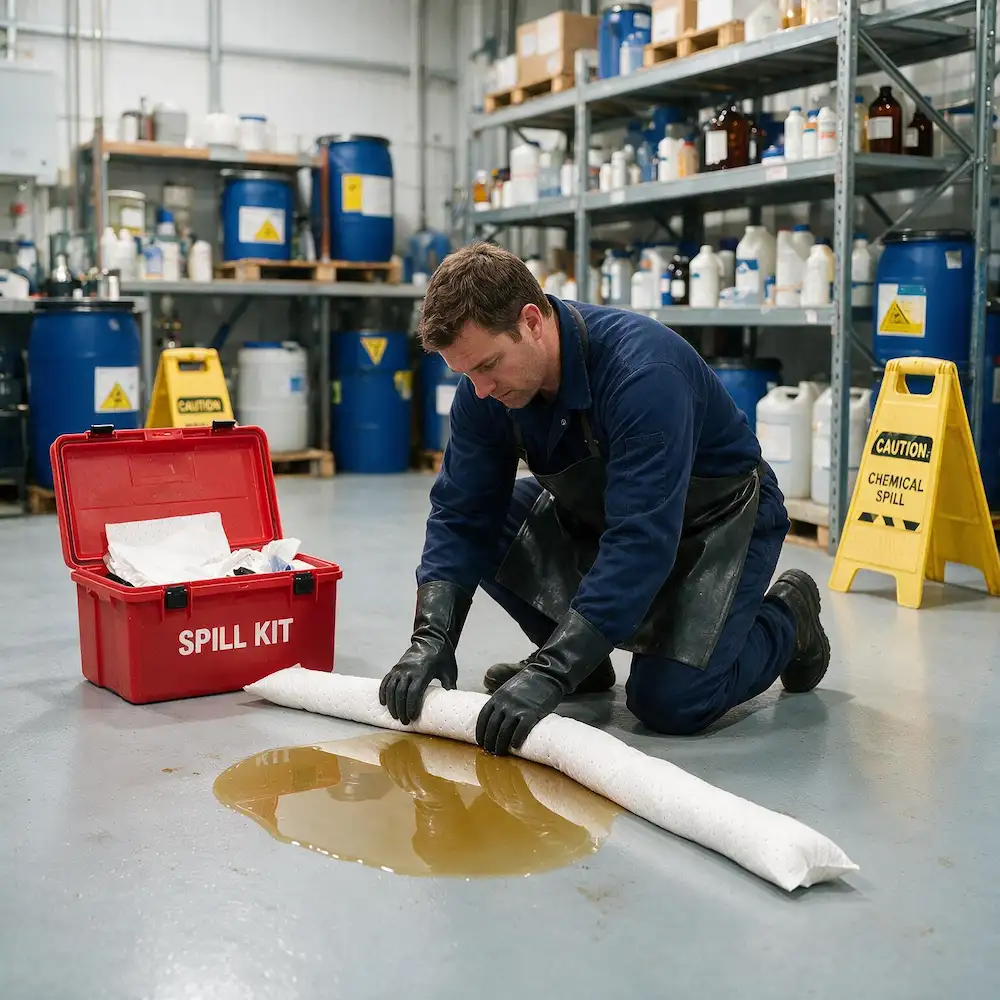
A spill kit is a pre-assembled set of equipment for containing and cleaning up a liquid spill safely. A typical kit includes absorbent pads, one or more absorbent socks (to form a barrier around the spill), a disposal bag for the used materials, and basic PPE such as gloves.
Larger kits, often supplied in a wheeled bin, add higher absorbent capacity and sometimes extra PPE like goggles or an apron.
The goal is simple: stop the liquid spreading, soak it up, and dispose of it correctly, without anyone coming into direct contact with a hazardous substance or the spill reaching a drain, watercourse or public area.
The three main types of spill kit
General purpose spill kits
Designed for water-based, non-hazardous liquids, such as spilt drinks, cleaning solution run-off, or condensation leaks. These use standard absorbent materials and do not need specialist chemical-resistant components. They are the right choice for offices, retail units, schools and most low-risk commercial premises.
Chemical spill kits
Built for acids, alkalis, solvents and other substances that would damage or react with standard absorbents. Chemical spill kits use chemically resistant pads and socks designed to handle corrosive or hazardous liquids without breaking down. These are essential in laboratories, hospitals, workshops, cleaning product stores and any site handling COSHH-regulated substances.
Oil and fuel spill kits
Purpose-built to absorb oil, diesel, petrol and similar hydrocarbons while repelling water, which matters if a spill happens near a drain or outdoors in wet conditions. Oil is one of the most common environmental pollutants reported in the UK, so these kits are standard in garages, plant yards, warehouses with vehicle fleets, and anywhere fuel or oil is stored or transferred.
Spill kit comparison table
| Feature | General Purpose | Chemical | Oil & Fuel |
|---|---|---|---|
| Absorbs | Water-based, non-hazardous liquids | Acids, solvents, corrosive chemicals | Oil, diesel, petrol, hydrocarbons |
| Typical sizes | 20L, 40L, 120L | 20L, 40L, 120L | 20L, 40L, 120L |
| Format | Break pack bag or wheelie bin | Break pack bag or wheelie bin | Break pack bag or wheelie bin |
| Best for | Offices, retail, schools | Labs, workshops, chemical stores | Garages, plant yards, fuel storage areas |
| Key risk if wrong kit used | Absorbent may not contain hazardous liquid safely | General pads can react with or fail to absorb chemicals properly | Standard absorbents can let oil pass through to drains |
What size spill kit do you need?
| Kit Size | Typical Use Case |
|---|---|
| 20L break pack | Small sites, vehicles, mobile tradespeople, or as a first-response kit backing up a larger fixed kit |
| 40L | Medium-sized workshops, single storage areas, small warehouses |
| 120L wheelie bin | Larger warehouses, sites with multiple storage areas or large drums, sites needing a mobile, quick-response kit that can be wheeled to the incident |
As a rule of thumb, size your kit to the largest single container of liquid you store or handle, not an average spill. A 20L kit next to a 200L drum will run out before the spill is under control.
How spill kits fit into your legal obligations
Spill kits themselves are not named as a specific legal requirement in UK law, but they are how businesses meet several requirements that are in law:
- COSHH (Control of Substances Hazardous to Health Regulations 2002): Employers must control exposure to hazardous substances, and the HSE’s own guidance on control measures explicitly includes having a way to capture and clean up spillages quickly as part of good control practice. Our complete guide to COSHH covers the wider requirements, including labelling and safety data sheets.
- Environmental protection law: Causing pollution to land, drains or watercourses is a criminal offence in England and Wales. Environment Agency guidance on pollution prevention has long recommended keeping a spill kit close to storage areas and training staff to use it correctly, a principle set out in PPG5: Works and Maintenance In or Near Water and stresses that spilt oil should never be hosed down or treated with detergent, since this can spread the pollution rather than contain it.
- Waste disposal: Once used, absorbents that have soaked up a hazardous substance typically need to be disposed of as hazardous waste through a registered carrier, rather than in general waste.
None of this needs to be complicated. A cleaning risk assessment that identifies where hazardous substances are stored or used is the natural place to decide what size and type of spill kit you need, and where it should be kept.
What should be in a spill kit?
At minimum, a spill kit should include:
- Absorbent pads for soaking up the bulk of the liquid.
- Absorbent socks or booms to form a barrier and stop the spill spreading, particularly towards drains.
- A disposal bag to seal and remove contaminated absorbents.
- Gloves to protect skin from contact with the spilt substance.
- Instructions a quick-reference card so anyone can use the kit correctly under pressure.
For chemical spills, check the safety data sheet for the substances you use most and confirm the kit’s absorbents are compatible; our guide to reading cleaning chemical labels explains how to interpret the hazard symbols that tell you what you are dealing with.
If a spill involves substances requiring more protection than gloves alone, our nitrile vs latex vs vinyl gloves guide explains which material to reach for.
Where to keep your spill kit
Placement matters as much as the kit itself. Good practice is to:
- Store it as close as possible to where a spill is most likely (storage areas, loading bays, workshop benches).
- Make sure it is clearly signed and visible, not tucked away in a locked cupboard.
Pair it with a wet floor or hazard sign to warn others while the spill is being dealt with. - Check contents periodically, since absorbents can be used up or damaged over time, and most kits offer refills rather than needing full replacement.
Frequently Asked Questions
There is no single law that names “spill kits” as mandatory, but if your business stores or handles hazardous substances, fuel or oil, having an effective way to contain and clean up a spill quickly is expected under COSHH and environmental protection law. A spill kit is the standard, practical way businesses meet that expectation.
A general spill kit is designed for water-based, non-hazardous liquids and uses standard absorbent materials. A chemical spill kit uses chemically resistant absorbents built to handle acids, solvents and other hazardous substances without breaking down or reacting.
No. Oil and fuel spill kits use absorbents designed to soak up hydrocarbons while repelling water, which is important if the spill is near a drain or outdoors. A general spill kit may not contain oil effectively and could let it reach a drain or watercourse.
Used absorbents that have soaked up a hazardous substance, oil, or fuel usually need to be disposed of as hazardous waste through a registered waste carrier, rather than in general rubbish. Check your local council or waste contractor’s guidance for hazardous waste collection.
Size your kit to the largest container or drum of liquid on your site, not the average spill. Small sites or vehicles are usually well served by a 20L break pack, while larger warehouses or multi-drum storage areas need a 40L or 120L wheelie bin kit.
Final thoughts
A spill kit is one of the cheapest forms of insurance a workplace can buy. Choosing the right type, sizing it correctly, and keeping it somewhere staff can actually reach in a hurry is what turns a five-minute clean-up into a genuine safety measure, rather than a box that sits unused until an inspection.
Browse our full range of general, chemical and oil & fuel spill kits in 20L, 40L and 120L sizes, and pair them with the right gloves and PPE and safety signage to keep your team compliant and prepared.
Sources referenced: HSE guidance on COSHH control measures (hse.gov.uk/coshh/basics/control.htm), HSE brief guide to COSHH INDG136 (hse.gov.uk/pubns/indg136.htm), Environment Agency/SEPA/EHS NI guidance PPG5: Works and Maintenance In or Near Water (geosyn.co.uk PDF), and NetRegs Guidance for Pollution Prevention GPP21: Pollution Incident Response Planning (netregs.org.uk PDF), produced on behalf of the UK’s environment agencies.

UK Cleaning Supplies Expert Insights Team
Trusted Commercial Cleaning & Hygiene Solutions
UK Cleaning Supplies supports businesses, schools, and facilities nationwide with trade-grade products, wholesale cost savings, and professional advice.
Our Expert Insights Team brings together industry knowledge across commercial cleaning, chemical procurement, and facilities management to share practical guidance that helps you maintain a safer, cleaner, and more cost-effective working environment.